권호기사보기
| 기사명 | 저자명 | 페이지 | 원문 | 기사목차 |
|---|
| 대표형(전거형, Authority) | 생물정보 | 이형(異形, Variant) | 소속 | 직위 | 직업 | 활동분야 | 주기 | 서지 | |
|---|---|---|---|---|---|---|---|---|---|
| 연구/단체명을 입력해주세요. | |||||||||
|
|
|
|
|
|
* 주제를 선택하시면 검색 상세로 이동합니다.
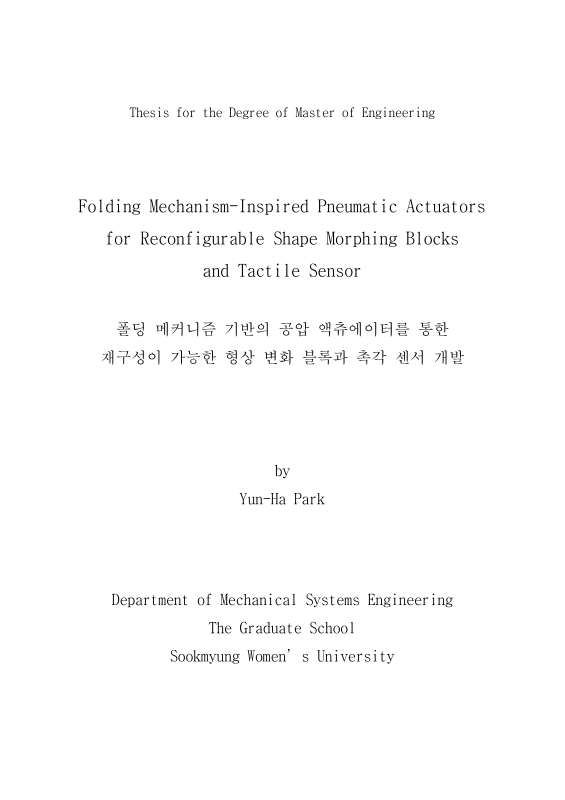
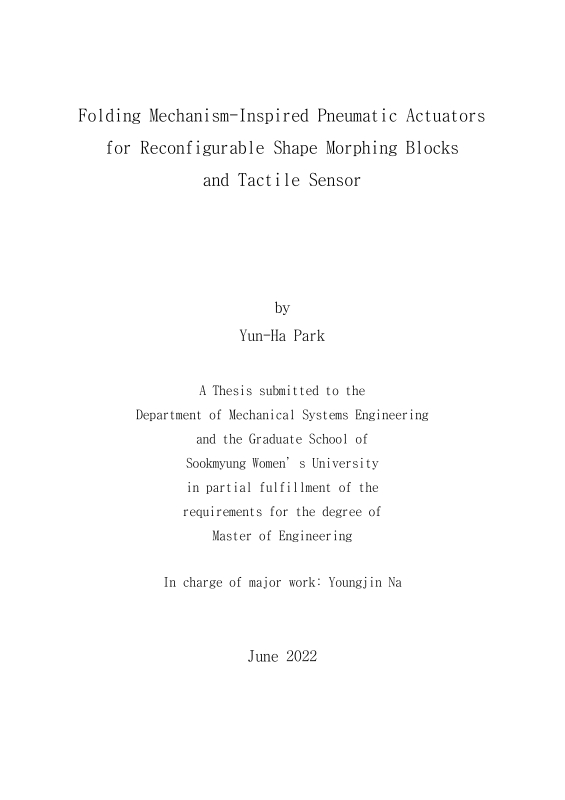
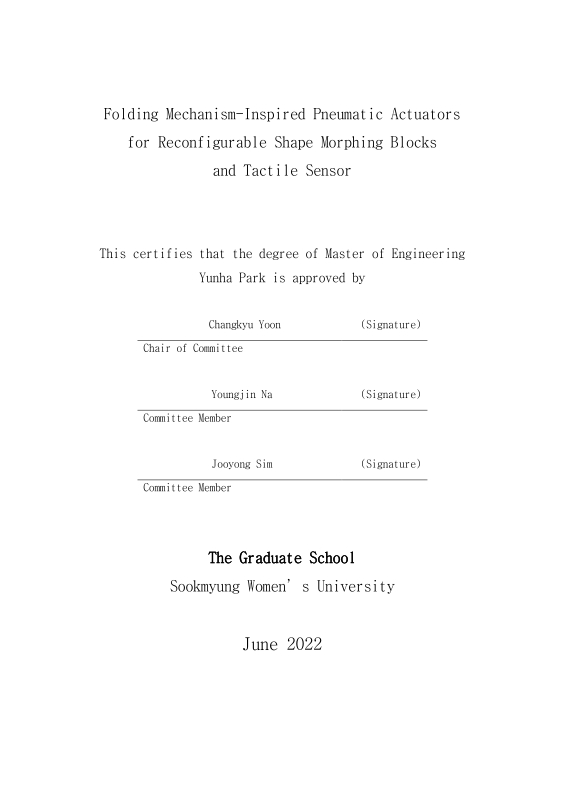
Title Page
Contents
ABBREVIATIONS 12
ABSTRACT 13
I. INTRODUCTION 15
1.1. Motivation 15
1.2. Research Objectives and Contributions 19
1.3. Research Overview 21
II. HARDWARE DESIGN AND METHOD 22
2.1. Shape Morphing Blocks 22
2.2. Inflatable Structure 26
2.3. Individual Block Activation 27
2.4. Theorical Backgroud for EIT 33
III. FABRICATION 38
3.1. Material 38
3.2. Deploying and Stakcing Method for Hardware 40
3.3. Tactile Sensor Fabrication 45
IV. EXPERIMENT AND RESULT 47
4.1. Reconfigurable Shape Morphing Blocks Performance 47
4.1.1. Properties of Single Block 47
4.1.2. Experiment Setup 49
4.1.3. Mechanical Performance of Multiblock 50
4.1.4. Individual Activations for Multiblock 59
4.2. Tatile Sensng Performance 62
V. CONCLUSION 70
VI. REFERENCES 73
ABSTRACT IN KOREAN 77
Figure 1. Folding mechanism-inspired pneumatic actuator. (a) reconfigurable... 20
Figure 2. Possible folding modes for the shape morphing block. (a) Single... 23
Figure 3. Two block design for comparison the energy. 25
Figure 4. Inflatable structure with bistablility. 26
Figure 5. Proposed design of the two passages for individual activation. 28
Figure 6. Stretchable pneuamtic passage. 28
Figure 7. Proposed design of the pneumatic custom valve and the valve... 31
Figure 8. Diagram of the block during inflation from state 1 to state 2. 31
Figure 9. Working mechanism of individual pneumatic activations for two blocks. 32
Figure 10. The materials of main two structures. (a) Reconfigurable shape... 39
Figure 11. Fabrication process for the shape morphing block. 42
Figure 12. Connection method for shape morphing block. (a) Vertical... 42
Figure 13. Fabrication process for the inflatable structure. 44
Figure 14. Fabrication process for the folding mechanism based tactile sensing. 46
Figure 15. Characterization of a single block in active and passive... 48
Figure 16. The experiment setting for measuring the force and deformation. 49
Figure 17. Pneumatic passage property. (a) Relation between the pneumatic... 51
Figure 18. Expansion and Compression force of the single block. (a)... 53
Figure 19. The four different multiblock for experiments of multiblock performance. 57
Figure 20. Response time and compression force for four different multiblock.... 57
Figure 21. Response time o f single block when location of activated block... 60
Figure 22. Changes of bending angle and length according to individual block... 61
Figure 23. Examples of individual activations for three-block stacked... 61
Figure 24. Folding simulation of sphere-to-rod folding mechanism-based... 65
Figure 25. Evaluation of the mechanical stress distribution from single-point... 66
Figure 26. Evaluation a piezoresistive performance of the proposed sensor... 68
*표시는 필수 입력사항입니다.
| 전화번호 |
|---|
| 기사명 | 저자명 | 페이지 | 원문 | 기사목차 |
|---|
| 번호 | 발행일자 | 권호명 | 제본정보 | 자료실 | 원문 | 신청 페이지 |
|---|
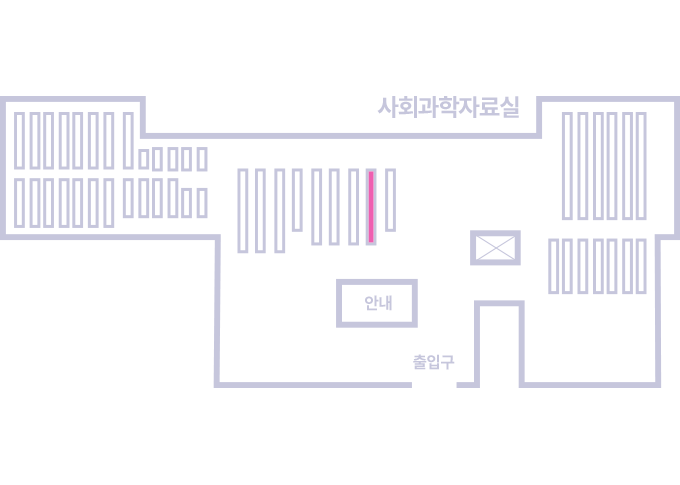
도서위치안내: / 서가번호:
우편복사 목록담기를 완료하였습니다.
*표시는 필수 입력사항입니다.
저장 되었습니다.