대표어
대표어


권호기사보기
| 기사명 | 저자명 | 페이지 | 원문 | 기사목차 |
|---|
결과 내 검색
동의어 포함
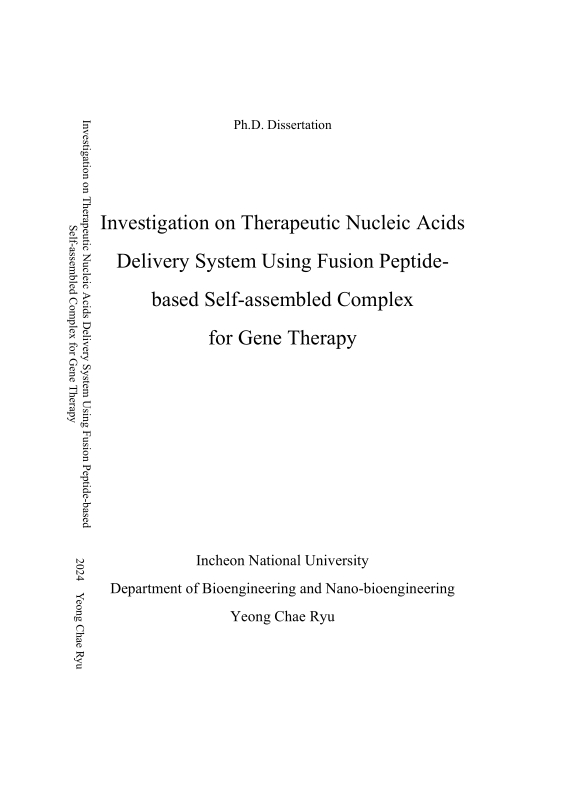
Title Page
Abstract
Contents
Chapter 1. Research background 19
1.1. Gene therapy 19
1.1.1. RNA interference 27
1.1.2. CRISPR/Cas9 32
1.2. Gene delivery systems 40
1.2.1. Gene delivery 40
1.2.2. Gene delivery systems 43
1.3. Functional peptides in gene delivery 54
1.3.1. Cell-penetrating peptides 55
1.3.2. Nuclear localization signals 68
1.3.3. Other peptides 76
1.3.4. Fusion peptide strategy 77
1.4. Self-assembled complex in gene delivery 78
1.4.1. Peptide-mediated gene delivery systems 78
1.4.2. Mechanisms of self-assembled complex in gene delivery 79
1.4.3. Influential factors in self-assembled complex 80
1.4.4. Properties and potentials of self-assembled complex 81
1.5. Research objectives 82
Chapter 2. Development of an efficient and safe small RNA delivery system using fusion peptide-mediated nanocomplex for gene silencing 85
2.1. Introduction 85
2.2. Experimental procedures 90
2.2.1. Materials 90
2.2.2. Preparation of small RNA/fusion peptide nanocomplexes 93
2.2.3. Characterization of small RNA/fusion peptide nanocomplexes 93
2.2.4. Intracellular delivery of nanocomplexes 96
2.2.5. Gene knockdown analysis 99
2.2.6. Endocytosis pathway study 102
2.2.7. Biocompatibility test of fusion peptide 102
2.2.8. In vivo fluorescence monitoring and imaging 103
2.2.9. Histological analysis 103
2.2.10. Statistical analysis 105
2.3. Results and discussion 105
2.3.1. Characterization of small RNA/fusion peptide nanocomplex 105
2.3.2. Evaluation of cellular uptake efficiency of nanocomplex 121
2.3.3. Gene silencing effect of nanocomplex 129
2.3.4. In vivo small RNA retention effect 134
2.3.5. Safety assessment of fusion peptide and nanocomplex 136
2.3.6. Mechanism study of nanocomplex 138
2.4. Conclusions 142
Chapter 3. Development of an efficient and safe large plasmid DNA delivery system using peptide-assisted lipoplex for gene editing 143
3.1. Introduction 143
3.2. Experimental procedures 147
3.2.1. Materials 147
3.2.2. Complexation of peptide-assisted lipoplex 148
3.2.3. Characterization of peptide-assisted lipoplex 149
3.2.4. Transfection of peptide-assisted lipoplex 151
3.2.5. Mechanism study of peptide-assisted lipoplex 155
3.2.6. pCas9-crRNA transfection 157
3.2.7. Histological analysis 163
3.2.8. Statistical analysis 163
3.3. Results and discussion 164
3.3.1. Characterization of peptide-assisted lipoplex 164
3.3.2. Evaluation of transfection efficiency and cellular activity of peptide-assisted lipoplex 170
3.3.3. Mechanism study of peptide-assisted lipoplex 187
3.3.4. Gene editing efficiency of peptide-assisted lipoplex 192
3.3.5. Therapeutic application of peptide-assisted lipoplex for cancer 202
3.4. Conclusions 211
Chapter 4. Overall conclusions 213
4.1. Conclusions 213
4.2. Future directions 215
1. Importance of controlling formulation in complex-based systems 215
2. Discussion on the overall manufacturing process of this system 216
3. Optimization in peptide design 216
References 218
국문초록 246
Figure 1.1. Gene therapy market size (2022 to 2032). The global gene therapy market was assessed at $6.5 billion in 2022 and is anticipated to surpass $38.76 billion by 2032, with an... 20
Figure 1.2. In vivo and ex vivo gene therapy approaches. In the context of gene-based drugs, in vivo application involves directly introducing the therapeutic gene into the patient's body, such... 24
Figure 1.3. Three major strategies in gene therapy. Gene augmentation entails the introduction of functional genes, gene silencing involves introducing genes that block defective genes, and gene... 26
Figure 1.4. Schematic representation of RNA interference mechanism. shRNA is encoded within a viral vector or plasmid and expressed, undergoing processing into siRNA by Dicer.... 28
Figure 1.5. CRISPR/Cas9-mediated gene editing by DNA repair mechanisms. In the error-prone NHEJ pathway, DSBs are repaired leading to random indel mutations at the junction site.... 37
Figure 1.6. Intracellular hurdles along the delivery of nucleic acids. Therapeutic nucleic acids must be specifically delivered to target cells and penetrate the cell membrane, possibly... 44
Figure 1.7. Proposed mechanisms of cellular internalization of cell-penetrating peptides. Direct translocation encompasses transient pore formation (toroidal and barrel stave models),... 58
Figure 1.8. Schematic model of nucleoplasmic transport of classical NLS-cargo protein. (a) Schematic model for classical NLS-cargo protein import. Importin β1 directs importin α to the... 73
Figure 1.9. Research objectives. In the first study, our primary aim was on the development of a small RNA delivery system using self-assembled nanocomplexes facilitated by a novel cell-... 83
Figure 2.1. Structure prediction of SPACE-R11 peptide. The α-helical secondary structures were visualized in red backbones. The image was obtained from PEP-FOLD4. 88
Figure 2.2. Schematic representation of Chapter 2. The objective of this study is to develop a small RNA delivery system using self-assembled nanocomplexes mediated by a novel cell-... 89
Figure 2.3. Confirmation of siRNA/peptide nanocomplex formation using gel retardation assay. The siRNA/peptide nanocomplexes were prepared with various N:P ratios (1:1, 5:1, 10:1, 20:1,... 106
Figure 2.4. Confirmation of shRNA/peptide nanocomplex formation using gel retardation assay. The shRNA/peptide nanocomplexes were prepared with various N:P ratios (1:1, 5:1, 10:1, 20:1,... 107
Figure 2.5. Size and zeta-potential of siRNA/peptide nanocomplex using DLS and ELS, respectively. The nanocomplexes with 200 nM siRNA were loaded in the cells and analyzed... 109
Figure 2.6. Size and zeta-potential of shRNA/SPACE-R11 nanocomplex at various N:P ratios using DLS and ELS, respectively. The nanocomplexes with 200 nM shRNA were loaded in the... 110
Figure 2.7. Size distribution by intensity according to N:P ratios of shRNA/SPACE-R11 nanocomplex. The nanocomplexes with 200 nM shRNA were loaded in the cells and analyzed... 111
Figure 2.8. Morphology and shRNA encapsulation efficiency of shRNA/SPACE-R11 nanocomplex. (A) Morphology of shRNA/SPACE-R11 nanocomplex. The nanocomplex (400 nM... 112
Figure 2.9. Nanocomplex-mediated stability of siRNAs in the presence of serum. In the left images, each siRNA/peptide nanocomplex was incubated in 10% FBS for 24, 48, 72, and 96 hours.... 115
Figure 2.10. Nanocomplex-mediated stability of shRNAs in the presence of serum. 25 pmol of shRNAs were mixed without or with each peptide at the 20:1 N:P ratio. The nanocomplexes were... 117
Figure 2.11. Size distribution of shRNA/SPACE-R11 nanocomplex in the presence of serum. The nanocomplexes incubated with 10% FBS for 4, 8, 12, and 16 hours were loaded in the cells and... 118
Figure 2.12. pH-dependent shRNA release profiles from nanocomplex. The nanocomplexes at the 1:1 and 20:1 N:P ratios were incubated in PBS (pH 7.4) and sodium acetate buffer (pH 5.5) at... 120
Figure 2.13. Observation of cellular uptake efficiency of Cy3-labeled siRNA/peptide nanocomplex in HeLa using a fluorescence microscope. The nanocomplexes with 200 nM Cy3-... 122
Figure 2.14. Cellular internalization of Cy3-labeled siRNA/FITC-labeled SPACE-R15 nanocomplex. (A) Single-molecule images of the siRNA/SPACE-R15 nanocomplex were... 123
Figure 2.15. Evaluation of cellular uptake of Cy3-labeled siRNA/peptide nanocomplexes using flow cytometry. The nanocomplexes with 200 nM siRNA were delivered into HDFn, HeLa, and... 125
Figure 2.16. Cellular uptake analysis of Cy3-labeled siRNA/SPACE-R11 nanocomplex in macrophages using a fluorescence microscope. (A) Observation of cellular uptake efficiency of... 127
Figure 2.17. Quantitative analysis of cellular uptake efficiency of Cy3-labeled siRNA/SPACE-R11 nanocomplex in macrophages and HEK293T using flow cytometry. (A) Cy3-labeled... 128
Figure 2.18. Target GAPDH mRNA knockdown analysis in HeLa and HaCaT by siRNA/peptide nanocomplexes using qRT-PCR. The nanocomplexes with GAPDH-siRNAs of final 200 nM... 130
Figure 2.19. Nanocomplex-mediated IL-23p19 mRNA knockdown analysis using qRT-PCR. RAW 264.7 cells were pre-treated with poly (I:C) of final 50 μg/mL for 6 hours. The... 132
Figure 2.20. In vivo gene silencing effect analysis using fluorescence imaging. pmCherry-N1 transfected HEK293T with 4 µg of free mCherry-siRNA (left) and siRNA/SPACE-R11... 133
Figure 2.21. In vivo fluorescence imaging of intratumorally administered siRNAs to tumor xenograft mice. 1 µg of free Cy3-labeled siRNA was administered intratumorally into the left... 135
Figure 2.22. Cell viability of fusion peptides. Relative LDH release of (A) SPACE-R7, (B) SPACE-R11, and (C) SPACE-R15-treated HDFn. Each fusion peptide was added to the cells for... 137
Figure 2.23. Histological analysis of siRNA/SPACE-R11 nanocomplex-injected skin tissues by hematoxylin and eosin staining. The siRNA/S-R11 nanocomplex was injected intradermally to... 139
Figure 2.24. Endocytosis pathway identification of Cy3-labeled siRNA/FITC-labeled SPACE-R15 nanocomplex using various chemical inhibitors. HeLa cells were pre-treated with each... 140
Figure 3.1. Structure prediction of SV40-R11 peptide. The α-helical secondary structures were visualized in red backbones. The image was obtained from PEP-FOLD4. 145
Figure 3.2. Schematic representation of Chapter 3. The objective of this study is to develop a large plasmid DNA delivery system using self-assembled lipoplexes mediated by a novel nuclear-... 146
Figure 3.3. Characterization of PAL. (A) Confirmation of PAL formation using gel retardation assay. SV40-R11 peptide was introduced to the lipoplex at each N:P ratio, followed by a 20-... 165
Figure 3.4. Size and zeta-potential of PAL-pCas9 using DLS and ELS, respectively. The PAL-pCas9 was diluted 10-fold with nuclease-free water and 1 mL of the diluted solution was loaded... 167
Figure 3.5. Stability test of pDNA in PAL-pCas9. 10% (v/v) FBS was added to each PAL-pCas9 and incubated at 37°C. Samples of 130 μL were collected at each time point. For pDNA... 169
Figure 3.6. Stability test of PAL-pCas9. (A) Overall size distribution of PAL-pCas9 over time in the presence of serum was measured using a zetasizer. (B) Average sizes of PAL-pCas9 at each... 171
Figure 3.7. Representative fluorescence cell counting analysis of PAL-pCas9. The PAL-pCas9 (0.8 μg of pCas9, 2 μg of Lipo2000, and specific N:P ratios of the SV40-R11 peptide) was added... 172
Figure 3.8. Average fluorescence cell counting analysis of PAL-pCas9. The PAL-pCas9 (0.8 μg of pCas9, 2 μg of Lipo2000, and specific N:P ratios of the SV40-R11 peptide) was added to the... 174
Figure 3.9. Cell recovery rate and cell viability after PAL-pCas9 treatment. (A) Relative cell recovery rate in HEK293T. The cell recovery rate was calculated by dividing the harvested cell... 176
Figure 3.10. Representative fluorescence cell counting analysis of PAL-pMasterE. The PAL-pMasterE (0.8 μg of pMasterE, 2 μg of Lipo2000, and 10:1 ratio of the SV40-R11 peptide) was... 178
Figure 3.11. Average fluorescence cell counting analysis of PAL-pMasterE. The PAL-pMasterE (0.8 μg of pMasterE, 2 μg of Lipo2000, and 10:1 N:P ratio of the SV40-R11 peptide) was added... 180
Figure 3.12. Cell recovery rate and cell viability after PAL-pMasterE treatment. (A) Relative cell recovery rate in HEK293T. The cell recovery rate was calculated by dividing the harvested cell... 181
Figure 3.13. mCherry intensity by PAL-pCas9 transfection in various cell lines. The PAL-pCas9 (1 μg of pCas9, 2.5 μg of Lipo2000, and 5:1 ratio of the SV40-R11 peptide) was added to the... 183
Figure 3.14. In vivo fluorescence analysis in mice injected with PAL-pCas9/HEK293T. The PAL-pCas9 (10 μg of pCas9, 25 μg of Lipo2000, and 5:1 ratio of the SV40-R11 peptide) was added to... 185
Figure 3.15. Mechanism study of PAL. (A) Endocytosis mechanism study using various endocytosis inhibitors. HEK293T cells were pre-treated with each inhibitor for 30 minutes. The... 188
Figure 3.16. Construction of pCas9-crRNA. (A) Linear vector map of the final pCas9-crRNAs. Each crRNA was synthesized as sense and antisense oligo strands. The cloning of crRNAs into... 193
Figure 3.17. Relative mean fluorescence intensity by PAL-crmCherry transfection in HEK293T. The PAL-crmCherry (0.8 μg of pCas9-crmCherry, 2 μg of Lipo2000, and 5:1 ratio of the SV40-... 194
Figure 3.18. TIDE analysis of PAL-crPLK1 #1. The PAL-crPLK1 #1 (0.8 μg of pCas9-crPLK1 #1, 2 μg of Lipo2000, and 5:1 ratio of the SV40-R11 peptide) was added to the HeLa cells for 48... 196
Figure 3.19. TIDE analysis of PAL-crPLK1 #2. The PAL-crPLK1 #2 (0.8 μg of pCas9-crPLK1 #2, 2 μg of Lipo2000, and 5:1 ratio of the SV40-R11 peptide) was added to the HeLa cells for 48... 197
Figure 3.20. TIDE analysis of PAL-crBCL2 #1. The PAL-crBCL2 #1 (0.8 μg of pCas9-crBCL2 #1, 2 μg of Lipo2000, and 5:1 ratio of the SV40-R11 peptide) was added to the HeLa cells for 48... 198
Figure 3.21. TIDE analysis of PAL-crBCL2 #2. The PAL-crBCL2 #2 (0.8 μg of pCas9-crBCL2 #2, 2 μg of Lipo2000, and 5:1 ratio of the SV40-R11 peptide) was added to the HeLa cells for 48... 199
Figure 3.22. Average indel efficiencies by PAL-crRNAs transfection in HeLa. 201
Figure 3.23. HeLa cell viability by transfection of PAL-crRNAs. The PAL-crPLK1 and PAL-crBCL2 (0.2 μg of pCas9-crRNAs, 0.5 μg of Lipo2000, and 5:1 ratio of the SV40-R11 peptide)... 203
Figure 3.24. Simultaneous delivery of Dox and PAL-crRNAs. Dox was added to the HeLa cells immediately after PAL-crRNAs treatment and incubated for 48 hours. (A) HeLa cell viability by... 206
Figure 3.25. Sequential delivery of Dox and PAL-crPLK1 #2. HeLa cells were pre-treated with Dox for 24 hours. The PAL-crPLK1 #2 was added to the cells for 48 hours. The CCK reagent was... 208
Figure 3.26. In vivo intratumoral delivery of PAL-crPLK1 #2 with Dox. (A) Overall procedures of in vivo experiments. HeLa cell mixtures were subcutaneously injected on both sides of the... 210
Figure 3.27. In vivo safety assessment. (A) Body weight changes of mice during in vivo experiments. (B) Histological analysis of PAL-injected skin tissues by H&E staining. The PAL... 212
Figure 4.1. Overall conclusions. This study aimed to develop a delivery system based on the functional fusion of peptides and self-assembled complexes, enhancing the efficiency, safety, and... 214
*표시는 필수 입력사항입니다.
| 전화번호 |
|---|
| 기사명 | 저자명 | 페이지 | 원문 | 기사목차 |
|---|
| 번호 | 발행일자 | 권호명 | 제본정보 | 자료실 | 원문 | 신청 페이지 |
|---|
도서위치안내: / 서가번호:
우편복사 목록담기를 완료하였습니다.
*표시는 필수 입력사항입니다.
저장 되었습니다.